

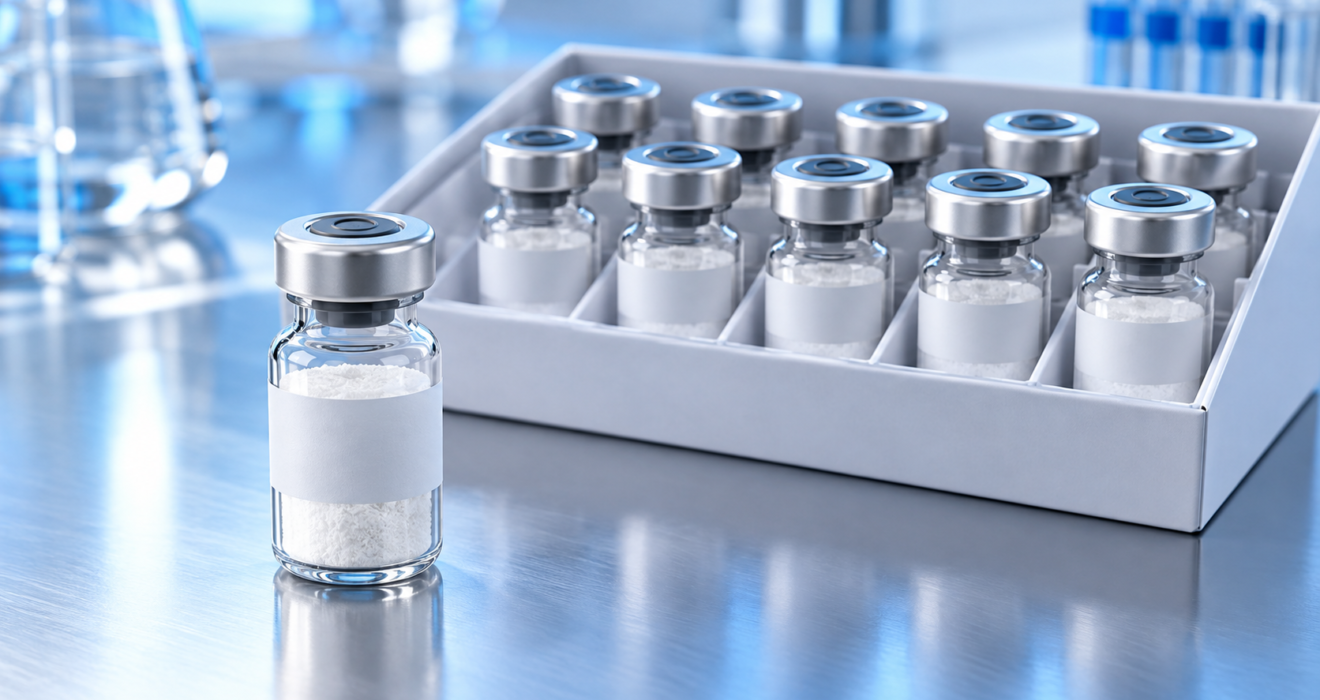
Peptide Kit Labels Explained: Milligrams per Vial, per Kit and per Component
The number in a product title may not describe the whole kit
A research peptide kit has several quantities worth separating: the number of vials, the amount stated for each vial, and the nominal total across the package. A blend adds another question: how much of each component does the label describe?
Before comparing prices, write those quantities on separate lines. A clear purchasing specification is more useful than a short product name.
Start with three fields
For a single-component product, record:
- The exact material and product identifier.
- The stated amount per vial and whether it is nominal or measured.
- The number of vials supplied.
If a hypothetical kit contains ten vials, each labeled with a nominal 10 mg, its nominal kit total is 100 mg. That is packaging arithmetic, not independent analytical confirmation that every vial contains exactly the printed amount.
Use the same distinction when reconciling a purchase order with a COA. The order describes what is being supplied; the report describes what was tested and reported.
Compare equivalent quantities before comparing prices
The following examples are invented to demonstrate the calculation. They are not current SPB prices or product specifications.
| Hypothetical offer | Nominal amount per vial | Vials per kit | Nominal kit total | Kit price | Price per nominal mg |
|---|---|---|---|---|---|
| A | 10 mg | 10 | 100 mg | $120 | $1.20 |
| B | 20 mg | 5 | 100 mg | $105 | $1.05 |
| C | 10 mg | 5 | 50 mg | $80 | $1.60 |
Offer C has the lowest package price but the highest price per nominal milligram. Offers A and B contain the same nominal total in different container configurations.
This table answers a pricing question only. It does not establish equivalent quality, appropriate packaging for your workflow, or comparable analytical evidence. Record shipping charges and any additional qualification costs separately if they affect your purchasing decision.
A blend needs a component-by-component statement
Now consider a hypothetical blend labeled “10 mg + 10 mg per vial.” If that wording explicitly refers to component A and component B, the stated combined amount is 20 mg per vial. Ten such vials would represent nominal totals of 100 mg of A and 100 mg of B.
A title that says only “10 mg blend” leaves a different impression. It may be read as a combined amount. Do not resolve that ambiguity by guessing from the price, cap color or another supplier’s naming convention.
Request a written specification that names each component and its amount. The analytical report should then be reviewed for the information it provides about those components. A single combined headline should not be treated as a substitute for understanding the reported individual results.
Copy this clarification request
Please confirm the exact product/SKU, number of vials per kit, nominal amount of each component per vial, and nominal total of each component per kit. Please identify the lot expected to ship and provide its associated analytical report. For any measured content result, please explain the units and reporting basis.
This request gives both parties a record they can compare against the invoice and received labels. It also reduces the chance that a technical team and a purchasing team approve different interpretations of the same product title.
For an example of separately stated purity and net quantity, see this Thermo Fisher peptide specification. It illustrates reporting terminology, not the specification of an SPB product.
Keep nominal and measured quantities in different columns
An internal purchasing sheet can use these headings:
| Field | What to enter |
|---|---|
| Ordered quantity | Vial count and nominal amount per component |
| Analytical result | Exactly what the report measured, with units |
| Sample reference | Report identifier and tested-sample identifier |
| Supplied lot | Identifier on the received material |
| Unresolved question | Missing or inconsistent information |
Leave a cell blank or mark it unconfirmed when the evidence is absent. A completed-looking spreadsheet is less valuable than an honest one.
Before placing an order
Check the current SPB catalog for the selected kit and the COA index for its supporting documentation. Resolve any mismatch among the title, description, report and expected shipment before relying on a quantity comparison.
Is a larger kit automatically better value? Only after comparing equivalent specifications, relevant costs and your laboratory’s actual requirements.
Does a nominal kit total replace a content measurement? No. Multiplying labeled amounts tells you the stated package quantity. It does not create a new laboratory result.
This guide concerns purchasing records for laboratory research materials. It is not a guide to preparation, administration or therapeutic use.