
Peptide Purity vs. Peptide Content: What Does “99%” Tell You?
A high percentage answers only the question that was tested
You open a research peptide report and see 99% purity. Before using that number in a purchasing decision, ask what the percentage measures.
Peptide purity, peptide content and the amount of powder in a vial are different quantities. A chromatographic purity result describes the sample under a particular analytical method. It does not, by itself, establish the number of milligrams of the intended peptide in the container.
That distinction matters when two suppliers use the same headline percentage but provide different supporting information.
What HPLC purity usually describes
When purity is reported as HPLC peak-area percentage, the result compares the integrated area assigned to the target with the relevant integrated peak areas under the stated method. Read the method and reporting basis rather than assuming every percentage is a mass fraction. A Thermo Fisher peptide specification illustrates how HPLC peak-area purity and net peptide quantity can be specified separately.
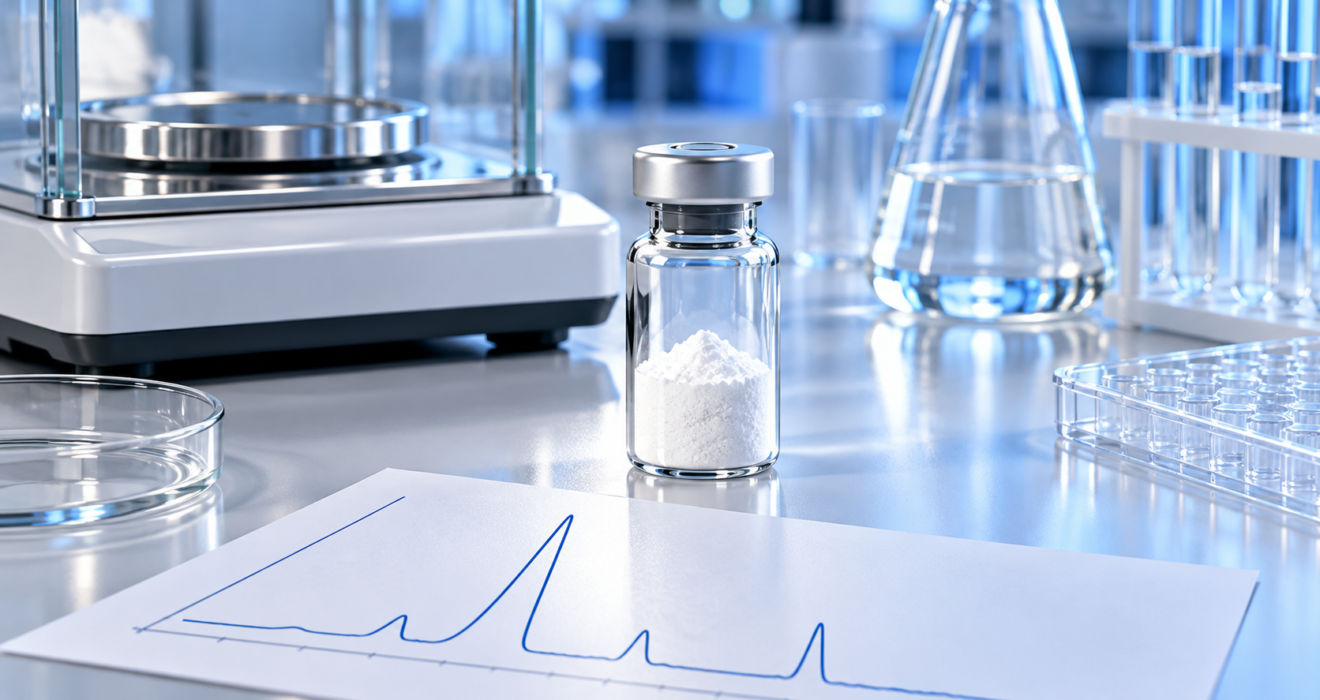
Consider this deliberately simplified, hypothetical chromatogram:
| Included signal | Integrated area |
|---|---|
| Peak assigned to the target | 990 units |
| Other included peaks | 10 units |
| Total included area | 1,000 units |
The target accounts for 99% of the included area: 990 divided by 1,000, multiplied by 100.
The calculation contains no measurement of vial weight. It therefore cannot, on its own, tell you how many milligrams the vial contains. This illustration is not an SPB batch result, and the simplified integration is not a substitute for reviewing a real method.
Powder weight and peptide content need their own definitions
A dried sample can contain water, salts, counterions and other material in addition to peptide. Gross sample weight and net peptide weight therefore need not be equal. MilliporeSigma’s peptide guidance explains this distinction.
When a report gives a content result, record its units and basis. Is it a percentage? An amount per vial? Is it measured or nominal? Does the laboratory define the reported quantity clearly?
Do not automatically multiply the vial’s printed milligrams by its HPLC purity percentage. That combines two values whose relationship may not have been established. Ask the laboratory or supplier which measurement supports the amount of target material being claimed.
Identity is a separate question
Purity asks about composition under a method; identity asks what the material is. Mass spectrometry can support identity by measuring mass. More detailed characterization may use fragmentation data to investigate sequence. Agilent’s synthetic peptide analysis overview distinguishes mass measurement from MS/MS sequence analysis.
Treat an identity statement according to the evidence actually supplied. Do not rewrite a basic mass match as exhaustive confirmation of every structural property.
A practical report-reading table
| What you see | What to clarify before relying on it |
|---|---|
| “99% purity” | Which method, reporting basis and sample does this refer to? |
| “10 mg” on a label | Is that a nominal fill, gross weight or measured target amount? |
| “Identity confirmed” | What analytical evidence supports that conclusion? |
| “Content: pass” | What was the specification, numerical result and unit? |
| One tested vial | How was it selected, and how does it relate to the supplied lot? |
Keep the answers beside the report in your procurement record. This makes later comparisons easier than saving a percentage alone.
The question to ask before comparing two products
Instead of asking only which has the higher purity number, ask whether both offers describe the same material, the same quantity basis and comparable supporting tests. If those elements differ, mark the comparison incomplete until clarified.
For SPB products, start with the current COA index, identify the relevant report, and read the actual result and method. For the broader authentication process, see the third-party COA verification overview.
Does high purity establish sterility? No. Do not infer an unreported property from a purity percentage. FDA specifications guidance treats sterility and endotoxin testing as separate quality attributes in its drug-product context; this does not certify any research product. FDA Q6A guidance.
Does a COA establish suitability for human use? An analytical report should not be read as such an authorization. SPB’s catalog is offered for laboratory research, not human or animal consumption or therapeutic use.